
More NOI from California buildings.
Get a free building energy assessment for your commercial or industrial property in California. We review your utility bill and your building, then tell you in writing where you can cut costs, and where you can earn.
Start with your property details. A utility bill is optional. A written initial review within 2 business days.
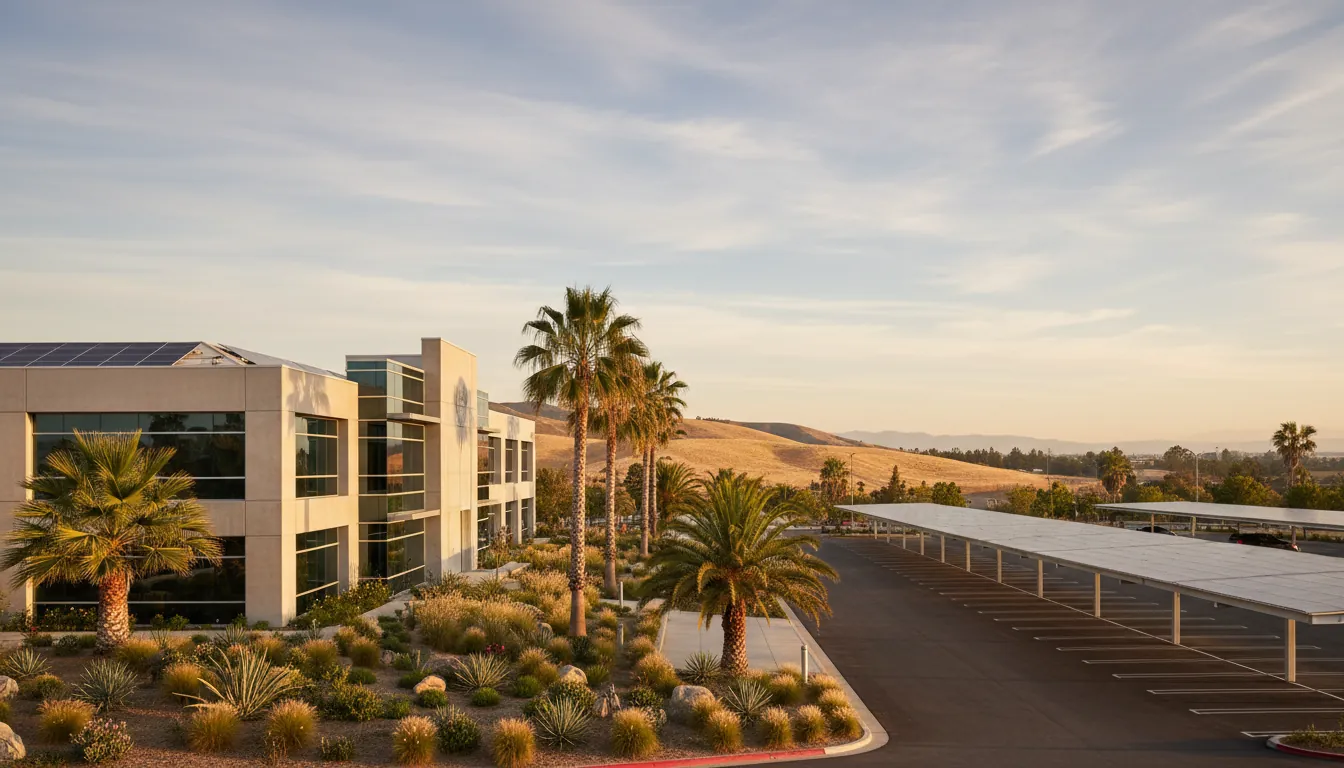
- SGIP storage budgets currently closed to new applicants — we track reopenings
- NEM 3.0 makes storage essential to solar economics
Tariff- and resilience-led evaluation. We do not represent that any state incentive program is currently open to new commercial applications.
We confirm the current rates and program rules for your property in the written review rather than quoting numbers we can’t stand behind.
Marina Del Rey, CA4210 Del Rey Ave(818) 424-3820
LED, solar, battery, HVAC and EV charging for California buildings
LED lighting
Swap old fixtures for LED and cut lighting costs across the property.
Solar
Make your own power on your roof or over your parking.
Battery storage
Store energy and use it when power is most expensive.
HVAC
Find where heating and cooling are wasting energy.
EV charging
Charging for staff, tenants and visitors that drivers pay to use.
How California businesses are billed, and what exported solar earns
PG&E, Southern California Edison and San Diego Gas & Electric are California's large investor-owned utilities.
Commercial billing
- Commercial rates combine time-of-use energy charges with demand charges. On SCE's TOU-GS-2 (20 to 200 kW), that means a facilities demand charge on the monthly maximum plus time-related demand charges in summer on-peak and winter mid-peak.
- Options on the same rate trade lower demand charges for higher energy charges, so the right option depends on the load shape.
Net metering and exports
- Systems applying to interconnect on or after April 15, 2023 take the Net Billing Tariff (CPUC D.22-12-056). Exports earn energy export credits at a value-to-grid rate that is usually below retail, with monthly billing and an annual true-up.
- System size is limited to the customer's annual load, plus up to 50% more if the customer attests to the need. So on-site use, and storage that shifts solar into the evening peak, usually matter more than export.
The 2025 Energy Code (Title 24) requires solar and battery storage on new nonresidential and high-rise multifamily buildings for permit applications from January 1, 2026.
Checked against these sources on October 7, 2026: CPUC, Net energy metering and net billing (accessed October 7, 2026); SCE, TOU-GS-2 rate fact sheet (2025); California Energy Commission, 2025 Building Energy Efficiency Standards. Tariffs and net metering rules change; we confirm the current version for each project. This is not legal or tax advice.
Programs NOI checks for California properties
Each program is modeled as its own line, and for qualifying projects NOI prepares the applications and handles enrollment and reporting. Every page shows the date we last checked it against its sources.
California SGIP (storage)
California's storage incentive: non-residential budget categories are currently closed.
California CALeVIP fast charging
Rebates for public DC fast chargers in California, in two 2026-27 windows.
Federal tax credits (48E, 30C, 179D)
The clean electricity investment credit for solar and storage, elective pay and transfer, and which credits have ended.


Free building energy assessment in California.
Start with your property details. A utility bill is optional. A written initial review within 2 business days.
Book my free assessment →