
BTR community — distributed rooftop solar
Ocala, Florida · Build-to-rent community, 148 homes plus amenity meter · 1.1 MW-DC distributed rooftop solar, no storage
A rental community where the addressable load is the amenity and common-area meter plus, where the metering structure allows, the individually metered homes. No demand component means no storage case — and we say that at stage 01 rather than designing a battery nobody needs.
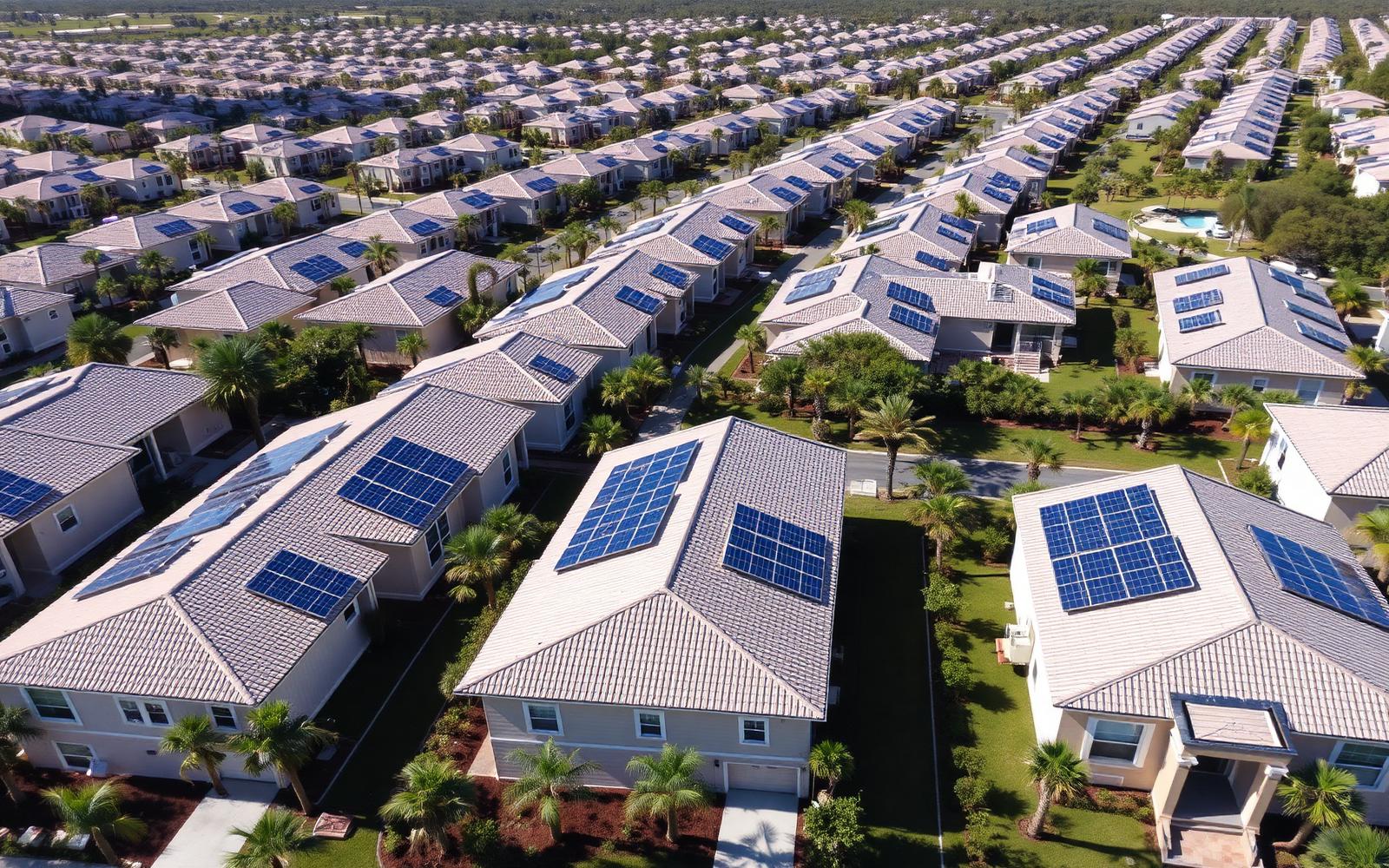
Representative photography of this site type. Not a photograph of a customer property.
- Modeled annual benefit
- $147,200
- Sum of the supported lines below only. Program performance value is excluded because it settles on measured dispatch.
- Demand charges today
- None
- No demand determinant on the addressable meters.
- Solar offset
- 71% of addressable usage
- 1,595,000 kWh/yr modeled production against 2,250,000 kWh/yr of addressable load.
- Residential-class service on the home meters with no demand determinant and no meaningful time differential.
- A small general-service amenity meter carries the only demand-style charge on the property, and it is too small to justify storage.
- Net metering rules decide how much of the production actually earns retail value.
- 148 pitched composition roofs, all under four years old, with south and west exposures usable on roughly 60% of them.
- Amenity building and pool equipment on a separate general-service meter.
- Distributed installation, so the cost driver is truck rolls and per-roof engineering, not a single large array.
- Per-home arrays of 6–9 kW-DC sized to each home's own consumption, not to roof capacity.
- Amenity array of 85 kW-DC on the clubhouse and carport structures.
- No storage. A battery on this tariff would add capital cost against a charge that does not exist.
Ocala, Florida: modeled annual economics, line by line
| Line | Modeled value | Basis |
|---|---|---|
| Energy offset from solar | $147,200 / yr | 71% of modeled production consumed on site at a $0.13/kWh blended rate; exported production is not valued here. |
| Demand-charge reduction | $0 | No demand determinant on the addressable meters. |
| Program performance payments | Not modeled | Not modeled as a dollar figure. Performance programs of this type settle on measured dispatch during declared events, so a nameplate figure would overstate the receipt. Eligibility, enrolment and settlement basis are confirmed per site before any case is issued. |
Modeled figures only. Not an operating result, not customer data, not a quote. Federal, state and utility incentive availability depends on project facts and applicable requirements; NOI does not provide tax advice.
- Who holds the meter — owner or resident — determines who can capture the benefit; this is a lease-structure question before it is an energy question.
- Net-metering rule changes move the value of exported production, which is why only self-consumed output is valued above.
- Roof warranty coordination across many homes affects schedule more than equipment lead times.
- 01 Tariff read
Amenity and sample home bills; confirmation that no demand component exists.
- 02 Site validation
Roof orientation and shading survey across the community; metering and lease review.
- 03 Design and underwriting
Per-home sizing, portfolio-level operating case, agreement covering resident-facing terms.
- 04 Permitting
County permitting per address and utility interconnection per meter.
- 05 Operations
Monitoring per array, maintenance routing, reporting at portfolio level.
Get a free energy assessment for your Florida property
Send the address, and a utility bill if you have one. A written read of your tariff within 2 business days, free, including when the answer is no.