
Rhode Island Renewable Energy Fund: commercial solar grants, by round.
Commerce RI's Renewable Energy Fund pays an upfront grant per watt for commercial-scale solar, with adders for solar carports and paired storage. Grants are awarded in competitive rounds with fixed deadlines.
The rule in one paragraph
The commercial program flyer (revised April 3, 2026) sets tiered grants for direct ownership: $0.70/W for the first 50 kW, $0.40/W for the second 50 kW, $0.30/W for the third and $0.20/W beyond that.
Adders: $0.55/W for solar carports and $0.50/W for paired storage, up to $40,000. Caps: $75,000 per application ($200,000 for carports) and $150,000 per installer per round. Non-profits may use third-party-owned systems.
Primary source: Commerce RI, Renewable Energy Fund commercial flyer (revised April 3, 2026); Commerce RI, Renewable Energy Fund.
Who it applies to
Commercial, non-profit and public property owners in Rhode Island installing eligible solar, applying in an open round.
On commercial projects the owner or developer applies; the application has to be complete by the round deadline.
What it costs / what it pays
The grant reduces upfront cost; it does not replace the federal credit, net metering or the Renewable Energy Growth program, which are evaluated separately.
Because rounds have fixed deadlines and per-installer caps, timing and installer choice affect whether a project receives the grant.
How NOI's structure fits
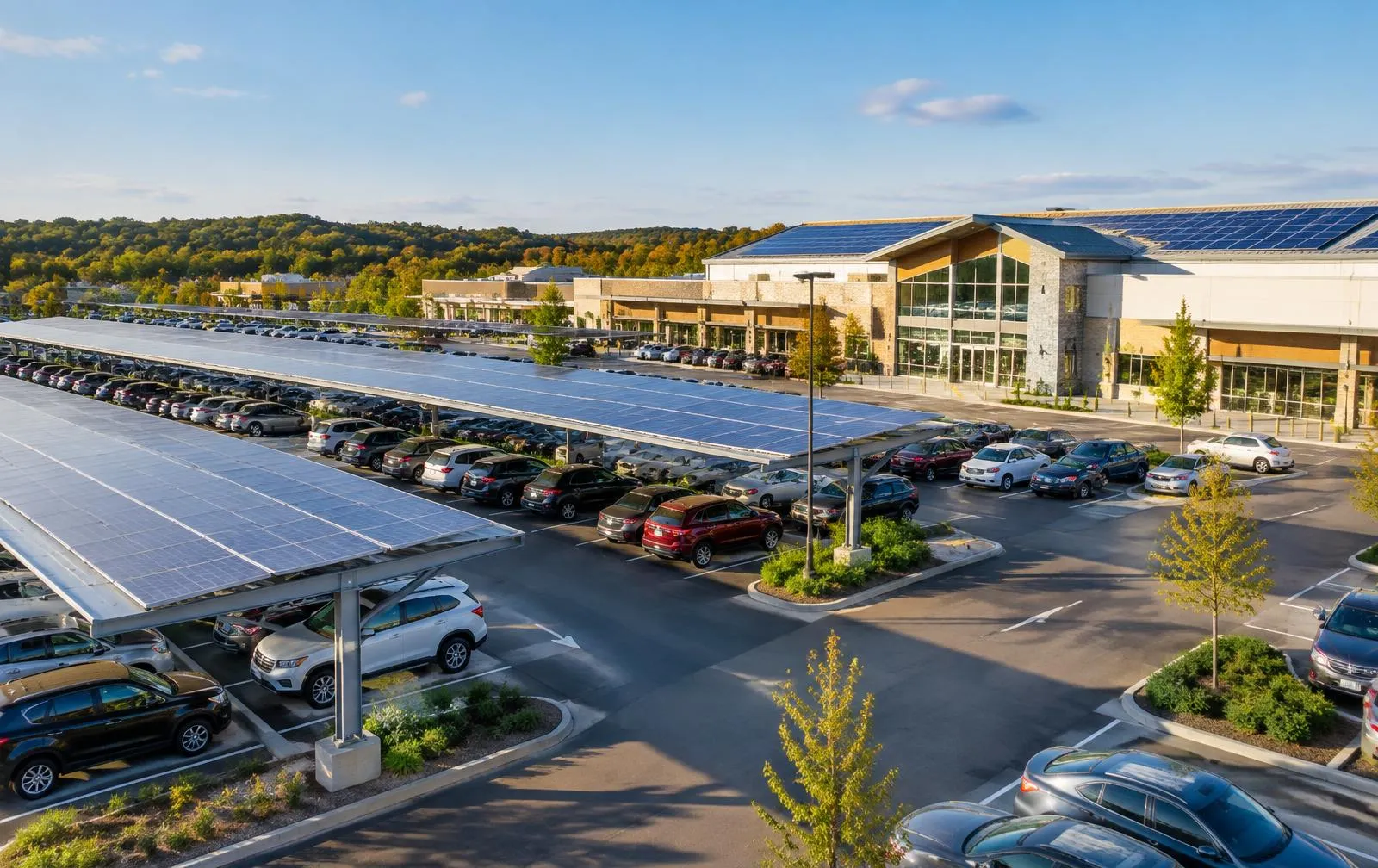
Rhode Island carport projects are a strong fit: the carport adder applies and the canopy can carry EV charging conduit. See solar carports.
Confirm the current round, tiers and caps with Commerce RI before signature; figures change between rounds.
Timeline
- QualificationSite, roof or carport option, and the next open round.
- Design reviewSystem size against the grant tiers and caps.
- ApplicationsGrant application by the round deadline; interconnection filing.
- After approvalsConstruction, commissioning and grant disbursement under the award terms.
Get your free building energy assessment
Start with your property details. A utility bill is optional. We review the program position and the operating case together.
Other programs in this section
Annual emissions limits on most NYC buildings over 25,000 sq ft, tightening in 2030.
ComplianceBoston's building emissions standard, with annual reporting and emissions limits phased in by building size.
ComplianceWashington DC's Building Energy Performance Standards, enforced on cycles with compliance pathways.
IncentiveNYSERDA's declining-block incentives for commercial and industrial solar across New York.
IncentiveNew Jersey's Successor Solar Incentive, community solar program, and what changed after TRECs.
IncentiveSMART 3.0 capacity and compensation schedules, adders, and how they are assessed alongside BERDO.
IncentiveConnecticut's non-residential renewable energy solutions tariff plus Energy Storage Solutions incentives.
IncentiveAlternative Energy Credits, PPL and PECO rebate programs, and the Act 129 efficiency framework.
IncentiveThe clean electricity investment credit for solar and storage, elective pay and transfer, and which credits have ended.
IncentiveUtility pay-for-performance for commercial batteries that discharge during summer peak events.
IncentiveLong-term financing for energy upgrades, repaid through a property assessment.
IncentiveCalifornia's storage incentive: non-residential budget categories are currently closed.
IncentiveRebates for public DC fast chargers in California, in two 2026-27 windows.
This page reflects our understanding as of October 7, 2026. Regulatory numbers and program rules move. Confirm current statute specifics with your tax and legal advisors before signature.